Ruth in a time before Kings
Ruth was a widow from a distant land that was blessed because of her faithfulness, passion, and obediance.
5/14/20264 min read
Historical Background: Ruth in a World Before Kings
When we read Ruth, we must remember that we are not reading a story set in the world of Rome, Jerusalem, churches, synagogues, governors, letters, prisons, and empire-wide roads like we saw in the New Testament. Ruth belongs to a much earlier and more unsettled world.
Ruth takes place “in the days when the judges ruled.” The judges were not courtroom judges and they were not kings. They were crisis leaders whom God raised up to rescue Israel during a time when the tribes had no central government, no capital city, and no national king. Some were faithful, some were deeply flawed, and most were regional deliverers rather than national rulers. Four of the twelve Judges that you may have heard of are; Deborah, Gideon, Samson, and Jephthah. The twelve Judges ruled for about 400 years.
That means Israel was not yet a monarchy. There was no King David, no royal capital in Jerusalem, no temple, no palace, and no strong central government. Israel was still a loose confederation of tribes living in the land, organized around families, clans, elders, tribal territories, and the covenant law God had given them.
In the biblical story, these people were descendants of those whom God had delivered from slavery in Egypt. They had been brought into the land, but they were not yet the settled nation we later see under David and Solomon. They were still becoming a nation. Their identity was rooted in God’s covenant, but their social and political life was still fragile.
This is one of the reasons the setting of Ruth matters so much.
Around this broad period, the eastern Mediterranean world was also going through enormous change. In his book 1177 B.C.: The Year Civilization Collapsed, Eric Cline describes the end of the Late Bronze Age as a time when great powers and trade networks began to break down. The old world of large empires, coastal cities, international trade, and powerful kingdoms became unstable. Drought, famine, migration, warfare, internal rebellion, and the movement of groups often called the Sea Peoples all contributed to a period of collapse and transition.
The coastal regions were especially affected. In the aftermath of this collapse, the Philistines emerged along the southern coastal plain. They became one of Israel’s most serious enemies in the period of the judges and later in the days of Saul and David. While the Philistines were becoming strong along the coast, early Israel was more closely associated with the hill country — smaller settlements, tribal life, family inheritance, and local survival.
That is the world behind Ruth.
It is not the world of a stable nation with a capital city and a king on the throne. It is a world of uncertainty. It is a world where famine could drive a family from Bethlehem to Moab. It is a world where widows could become extremely vulnerable. It is a world where a foreign woman like Ruth could easily be ignored, rejected, or mistreated.
And yet, in that unsettled world, God was working.
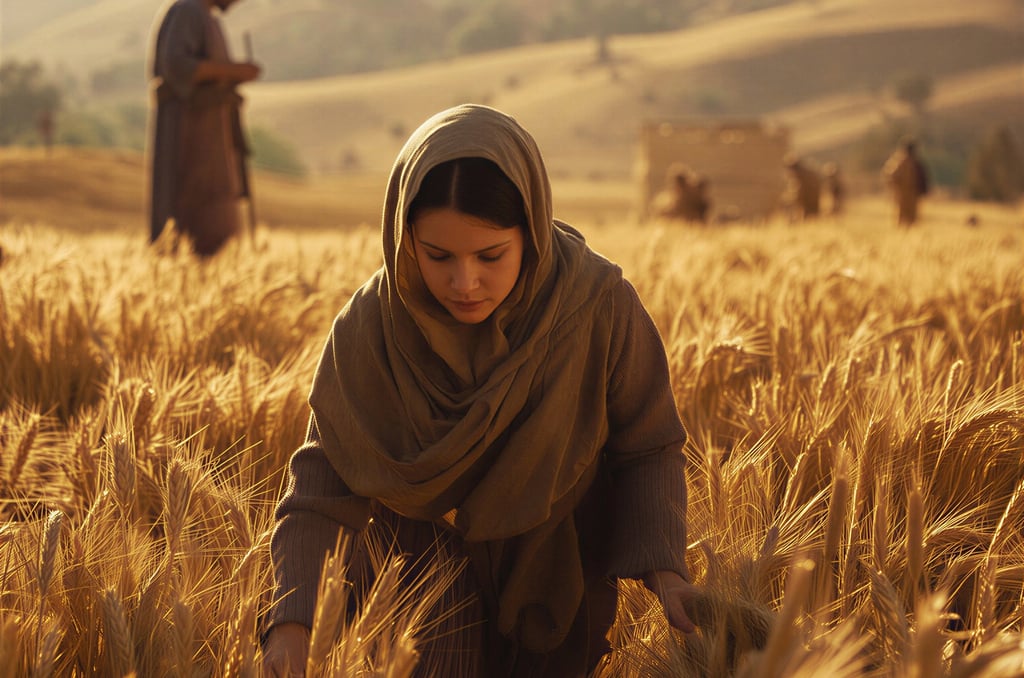
Ruth 2 does not take us to a battlefield, a palace, or a throne room. It takes us to a barley field in Bethlehem. That may seem small compared to collapsing empires and rising enemies, but the Bible is showing us something powerful: God often builds His greatest purposes through ordinary people in ordinary places.
Boaz matters because he shows us what covenant faithfulness looks like before Israel has a king. He is not forced by a government to protect Ruth. He is not ordered by a royal court to obey the gleaning laws. He is not seeking political power. He is simply a godly man, living faithfully in a dangerous and morally unstable time.
Ruth matters because she shows courage, loyalty, humility, and faith when she has no earthly guarantee of security. She is a Moabite widow in Israel, yet she steps into the field and trusts that somehow God will provide.
Naomi matters because she represents a broken life slowly beginning to see hope again. She came back to Bethlehem empty, but in Ruth 2 God begins to fill what has been emptied.
This is why Ruth is more than a sweet love story. It is a story of redemption planted in the soil of national uncertainty.
Before Israel had a king, God was already preparing the line of David.
Before Jerusalem became the capital, God was already working in Bethlehem.
Before David faced the Philistine giant, God was arranging the family line that would bring David into the world.
And long before Christ was born in Bethlehem, God was already moving through a widow, a foreigner, a field, and a man of kindness.
The great world may have been shaking, but God’s redemptive plan was not shaking.
The Bronze Age may have been collapsing. Coastal powers may have been changing. Israel may have been only a loose federation of tribes. But in Bethlehem, God was quietly writing the next chapter of His promise.
That is the beauty of Ruth 2.
In a time without a king, Boaz acts like a man under God’s kingship.
In a time of famine and loss, Ruth takes the next faithful step.
In a time when Israel is still becoming a nation, God is already preparing the family that will lead to David — and ultimately to Jesus Christ