From Ruth’s Barley Field to Esther’s Palace
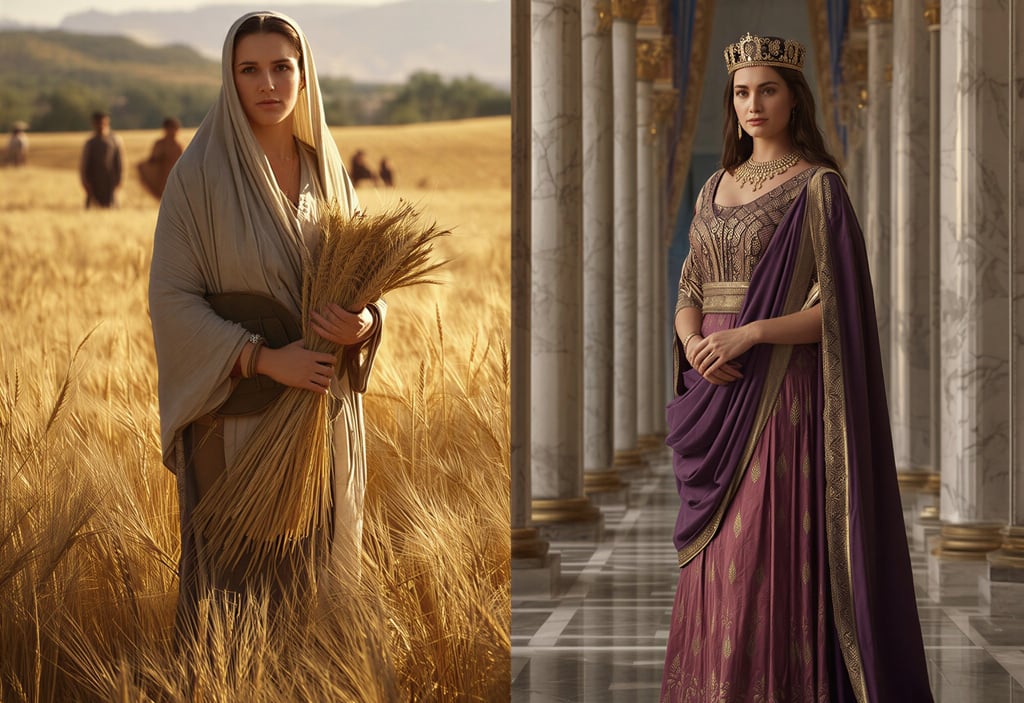
Ruth and Esther stand in contrasting settings—one in the barley fields of Bethlehem, the other in the royal palace of Persia. Ruth represents humble faithfulness, while Esther represents beauty, courage, and influence. Though separated by centuries and circumstance, both women were used by God to preserve His people and advance His redemptive pl
5/14/20265 min read
My post content
From Ruth’s Barley Field to Esther’s Palace
The only two books in the bible named after women are Ruth and Esther. Both amazing accounts of how God worked through redemption and restoration, yet only 15 times in both God’s name was used, but his fingerprints were obvious.
The first book named after a woman was about six hundred years before Esther walked into the palace of Persia. Not a stunningly beautiful woman, but a widow woman from a different land that entered a barley field near Bethlehem.
Her name was Ruth.
Ruth lived during the rough and unsettled days of the judges, around the eleventh century BC. Israel had no king, no grand palace, and no powerful central government. Bethlehem was a small farming village where families survived through harvests, land, marriage, and the protection of their relatives. Ruth’s world was made up of dusty roads, barley fields, village elders, and ordinary people trying to remain faithful during difficult times.
Ruth was a poor widow from Moab. She arrived in Bethlehem with Naomi possessing almost nothing. There was no beauty contest, no royal wardrobe, and no palace attendant waiting to prepare her.
She simply went to work.
Her faithfulness attracted the attention of Boaz, and their marriage eventually produced the family line of King David—and ultimately Jesus Christ.
Now move the clock forward roughly six hundred years.
In this new book the little town of Bethlehem has been replaced by the magnificent royal city of Susa, in what is now the city of Shush, which is a southwest providence Iran. Israel’s kings had come and gone. Jerusalem had been destroyed by Babylon, and many Jewish people had been carried away into exile.
Babylon was later conquered by Persia. Some Jews returned to Jerusalem, but many remained scattered throughout the Persian Empire. Esther and Mordecai belonged to that Jewish community living far from their ancestral homeland. Esther is set more than a century after the Babylonian exile, in the Persian royal court at Susa.
Instead of living under local judges, Esther lived beneath the authority of the most powerful monarch in the known world.
King Ahasuerus—commonly identified as Xerxes I—ruled from approximately 486 to 465 BC. His empire extended from India to Africa and included many peoples, languages, armies, and provinces.
Xerxes possessed enormous wealth inherited from his father, Darius. Taxes, tribute, trade, agriculture, royal lands, and the resources of conquered nations poured into the Persian treasury.
Imagine a modern ruler who controlled much of Europe, the Middle East, northern Africa, and parts of Asia. Imagine the White House, Buckingham Palace, the Pentagon, Wall Street, and the United Nations all combined under one man’s authority.
That begins to give us a picture of Xerxes.
His palace at Susa was not a modest government building. It was the headquarters of a world empire—a place of marble columns, colored tiles, royal gardens, military commanders, servants, treasures, banquets, and political intrigue.
In the third year of his reign, around 483 BC, Xerxes invited the most powerful officials in the empire to a celebration lasting 180 days.
This was probably not merely the world’s longest cocktail party.
Xerxes was preparing for war.
A few years later, in 480 BC, he led a massive Persian invasion of Greece. His forces fought at Thermopylae, where King Leonidas and the famous Spartan defenders resisted the Persian army. Xerxes eventually broke through and captured Athens, but his fleet suffered a disastrous defeat at Salamis.
Therefore, the opening banquet of Esther may be imagined as a combination of:
a presidential summit,
a military planning conference,
a political fundraiser,
and the most extravagant corporate retreat in history.
Xerxes was showing his officials:
“Look at my wealth. Look at my army. Look at what I can provide. Follow me, and together we will conquer Greece.”
Then, during the final banquet, the king decided to display one more possession—Queen Vashti.
The Bible does not say Vashti hated Xerxes, nor does it reveal exactly why she refused to appear. Later stories speculate about her motives, but Scripture simply tells us that the king summoned her and she said no. Ancient Persian royal women normally lived with considerable seclusion, so appearing before a large gathering of drinking men may have violated her dignity or accepted court practice.
Her refusal humiliated the most powerful man in the world.
Xerxes could command armies, collect taxes, invade nations, and issue laws across 127 provinces—but he could not make his own queen enter the room.
In wounded pride and anger, he removed Vashti from her position.
Suddenly, Persia needed a new queen.
In modern terms, the palace launched the most important beauty search in the empire.
Officials traveled throughout the provinces looking for attractive young women. They were brought to Susa and placed under the care of Hegai, the royal official responsible for the women.
Among them was an orphaned Jewish girl named Hadassah, better known by her Persian name, Esther.
Esther may not have arrived wearing a sash that said “Miss Persia,” but she apparently had all the qualifications.
She was exceptionally beautiful—what we might carefully call stunningly attractive. But she was more than beautiful. The Bible says Esther gained the favor of Hegai and of everyone who saw her.
So, using our modern comparison, Esther may have been:
the favorite to win Miss Persia,
the winner of Miss Congeniality,
and the young woman everyone noticed when she entered the room.
She possessed a rare combination of outward beauty and inward grace.
Esther did not demand special clothing, jewelry, or attention. She listened to Hegai, accepted his advice, and carried herself with humility and restraint.
The other women may have tried to impress the king by asking for every jewel and luxury available.
Esther apparently understood that sometimes the person who tries least to impress everyone becomes the most impressive person in the room.
When Xerxes met her, she stood out.
He placed the royal crown upon her head and made her queen.
But Xerxes did not know that Esther was Jewish.
He saw a beautiful and gracious young woman.
God saw the person who would one day stand between her people and destruction.
Ruth and Esther lived in very different worlds.
Ruth’s story unfolded among ordinary people in a small village. Esther’s story unfolded among rulers and officials in the largest empire of its time.
Ruth entered the field with nothing but faithfulness.
Esther entered the palace with beauty, grace, and a hidden identity.
Ruth helped preserve the family line through which the Messiah would come.
Esther helped preserve the Jewish nation from which the Messiah would come.
And in both stories, God used a woman who initially appeared powerless.
Ruth was a foreign widow.
Esther was an orphaned exile.
Neither woman began with wealth, rank, or authority. Yet both were placed by God at exactly the right place, at exactly the right time.
In Ruth, God worked through a field, a harvest, and a family redeemer.
In Esther, God worked through a banquet, a beauty search, a sleepless king, and a royal throne.
The setting changed from Bethlehem’s barley fields to Persia’s golden palace—but the unseen hand of God had not changed.
Ruth shows God preserving one family. Esther shows God preserving an entire people. Both stories lead us toward the same greater plan of redemption.